Computer > Hardware > Memory > What is DIMM?
What is DIMM?
DIMM or Dual In-Line Memory Module, comprises a series of random access memory integrated circuits. These modules are mounted on a printed circuit board and designed for use in personal computers. DIMMs began to replace SIMMs (Single In-Line Memory Modules) as the predominant type of memory module as Intel's Pentium processors began to control the market. The DIMMs have a 64-bit data path.
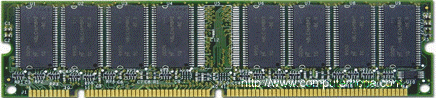
The most common types of DIMMs are:
72-pin SO-DIMM , used for FPM DRAM and EDO DRAM
100-pin DIMM, used for printer SDRAM
144-pin SO-DIMM, used for SDR SDRAM
168-pin DIMM, used for SDR SDRAM (less frequently for FPM/EDO DRAM in workstations/servers)
172-pin MicroDIMM, used for DDR2 SDRAM
184-pin DIMM, used for DDR SDRAM
200-pin SO-DIMM, used for DDR SDRAM and DDR2 SDRAM
214-pin MicroDIMM, used for DDR2 SDRAM
240-pin DIMM, used for DDR2 SDRAM, DDR3 SDRAM and FB-DIMM DRAM
There are 2 notches on the bottom edge of 168-pin-DIMMs, and the
location of each notch determines a particular feature of the module.
usually it is 13cm for desktop version and 15cm for server version.
The first notch is DRAM key position. It represents RFU (reserved future use), registered, and unbuffered.
The second notch is voltage key position. It represents 5.0V, 3.3V, and Reserved.
The upper DIMM in the photo is an unbuffered 3.3V 168-pin DIMM.
A DIMM's capacity and timing parameters may be identified with SPD
(Serial Presence Detect), an additional chip which contains information
about the module type.
ECC DIMMs are those that have extra data bits which can be used by the
system memory controller to detect and correct errors. There are
numerous ECC schemes, but perhaps the most common is Single Error
Correct, Double Error Detect (SECDED) which uses a 9th extra bit per
byte.
